

When my physical therapist first suggested a TENS unit, I nodded politely and then did nothing about it. I had a mental picture of clunky boxes with wires and a faint electric buzz, and I was not convinced that little pulses through my left knee could do anything a heating pad could not. Then my daughter-in-law, a nurse, mentioned that she used an AUVON unit on her shoulder after long shifts and had bought a second one for her mother. That recommendation carried more weight than any advertisement ever could.
I have had mild to moderate osteoarthritis in my left knee for about four years. The right knee is fine, which means I notice the left one constantly. It is worst on stairs, after long car rides, and first thing in the morning. I am 62, retired from school nursing, and I walk my neighborhood most mornings and tend a vegetable garden out back. I did not want a gadget. I wanted my knee to stop being the first thing I thought about when I swung my legs out of bed.
The Quick Verdict
After six weeks of near-daily use, the AUVON TENS unit did not cure my arthritis and it did not make the stairs disappear. What it did was give me 20 to 30 minutes of genuine relief when my knee was at its worst, reliably enough that I reached for it instead of the heating pad. If you want a tool that helps you through the bad hours, this is a good one. If you want a fix, no TENS unit is that.
Amazon Check Today's Price →The AUVON unit I tested for six weeks, starting as a skeptic
I have used this TENS unit almost daily for six weeks on a knee that has bothered me for four years. It is the one knee gadget in my drawer that still gets used. Check today's price on Amazon and see if it fits your budget.
Amazon Check Today's Price on Amazon →How I've Used It
I tested this the way a normal person would, not the way a reviewer with a stopwatch would. I did not read the manual cover to cover on day one. I opened the box, found the quick start card, and figured out the rest as I went. The unit came with the device itself, four adhesive pads, the wires, a USB charging cable, and a small carrying pouch. The first thing I noticed was how small it is. It fits in the palm of my hand, which surprised me, because I had pictured something bulkier. The screen is simple, with a few buttons, and a dial cycles through 24 modes. I mostly used two of them, which I will get to in a minute.
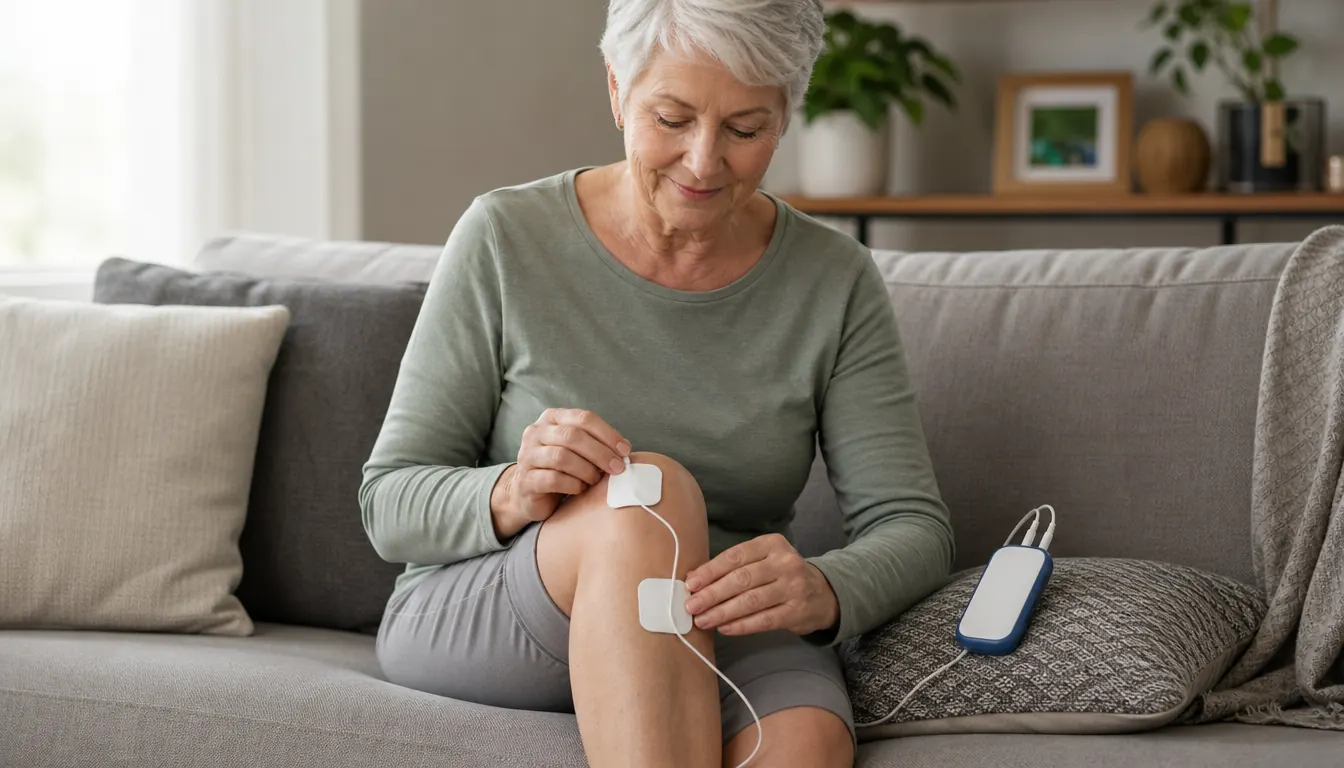
To be honest, the first session was not a revelation. I tried it on a Tuesday morning, sitting in the same armchair where I drink my coffee. I had the manual open on the armrest and still managed to put the pads slightly crooked the first time, and it took me a few tries to realize the cable connectors click in only one way. Once the pads were where the diagram showed, one above the knee and one below, I turned the intensity up slowly and felt a tingly, tapping sensation that was pleasant but not dramatic. I kept it on for 20 minutes while I sat and read. When I stood up, my knee felt looser. Not pain-free, but looser, the way it feels after a good stretch. The session itself was unremarkable, which is exactly what I needed it to be. That was enough to make me try it again the next morning.
Over the next six weeks I used it at different times of day to see when it helped most. The answer turned out to be the morning, when my knee is stiffest, and after long car rides, when it aches the most. I also used it in the evening a few times after a long day of gardening, and it helped then too, though less dramatically.
What the AUVON TENS Unit Actually Does (in Plain Language)
I will not pretend to be an expert on how TENS works, because I am not. What I understand from my physical therapist is this: TENS stands for transcutaneous electrical nerve stimulation, which is a fancy way of saying the unit sends gentle electrical pulses through pads on your skin, and those pulses are thought to interfere with the pain signals traveling from your knee to your brain. It is like turning down the volume on the pain signal, not deleting the message.
The AUVON unit has 24 modes, and honestly, that number is more intimidating than it needs to be. The modes are mostly variations on pulse patterns: some are steady, some pulse in waves, some feel like a tapping, some feel like a massage. I found a steady low setting and a wave setting that I liked, and I stayed there. You do not need to master all 24 to get value out of this unit. You need to find the one or two that feel right and learn where to place the pads.
The intensity dial goes from 1 to 20, and this is where I will give you the advice nobody gave me: start at 1 and go up slowly. The difference between 'that feels good' and 'that is too much' is smaller than you expect. I learned this the hard way on day three, when I turned the dial from 8 to 10 mid-session, thinking one notch would not matter, and the next pulse made my whole leg jump. My husband Ray looked over from his chair and asked if I was all right. After that I made a rule for myself: never move the dial more than one number at a time, and wait a full minute before deciding it is not strong enough. On my knee, I settled around level 8 or 9. On my shoulder, which I tried once out of curiosity, I needed less. You will find your own number, and it will probably change from day to day.
What Nobody Tells You Before You Buy One
Here is the honest part, and it is the reason I wanted to write this review at all. Most of the reviews for this unit are glowing, and the unit deserves most of them. But there are things I figured out the hard way, and I would rather tell you now than have you discover them after you have already unpacked the box.
First, the pads are the real cost of owning a TENS unit, not the unit itself. The four pads that come in the box are good pads, but they do not last forever. I noticed it first on a Thursday morning, about three weeks in, when the pad above my knee peeled up at the corner while I was still settling into my chair. The session still worked, but I had to press the pad back down twice. By the fifth week I was rinsing the pads with water and letting them air dry, which bought me another week or so. AUVON sells replacement pads, and you should budget for them, or order a spare set with the unit so you are not waiting on shipping when yours wear out. This is not a complaint about the product. Every TENS unit on the market has this same issue. It is just something I did not know before I bought one.
Second, placement matters more than the mode. The difference between a session that helps and a session that does nothing is often just an inch or two of pad placement. On my knee, the sweet spot turned out to be one pad above the kneecap and one below it, slightly to the outside. When I placed them too close together, the sensation was sharp and not useful. When I placed them too far apart, I barely felt anything. Give yourself a few sessions to find your own sweet spot, and do not be afraid to move the pads a little.
Third, the wires are fine, but they are wires. The unit connects to the pads with thin cables, and you will occasionally catch one on a chair arm or have to untangle them before a session. It is a minor annoyance, not a deal breaker, but I mention it because the product photos make the whole thing look wireless. It is not.
On mornings when I used the AUVON unit for 20 minutes, the stiff period got shorter and the first steps were easier.
Six Weeks With It: What Changed and What Didn't
This is the section I would have wanted to read before buying, so I will be specific. The mornings are better. Not dramatically better, but noticeably. On a typical morning, my left knee used to take a good 10 to 15 minutes to loosen up, and the first few steps down the hallway were the worst. On mornings when I used the AUVON unit for 20 minutes with my coffee, that stiff period got shorter, and the first steps were easier. That improvement did not fade over the six weeks. If anything, it got more consistent as I got better at placing the pads.
The stairs are the honest test, and I have to tell you the truth: the stairs are still the stairs. The unit did not make stair climbing pain-free, and I did not expect it to. What it did was take the edge off. The sharp, catching feeling I used to get on the way down got softer on the days I used it. My physical therapist would say the unit is a tool for symptom management, not a treatment for the underlying arthritis, and after six weeks I understand exactly what she means.
The biggest surprise was how much it helped after long car rides. We drove to see my sister in Oklahoma City, about a two-hour drive. We left at nine in the morning and stopped once for gas, and by the time we pulled into her driveway my left knee was stiff, the way it always is after I sit still that long. Instead of reaching for the heating pad, I sat on the edge of her guest bed with the unit on level 8 while Ray carried in the cooler. After 20 minutes the familiar ache from sitting in one position had settled into a dull background hum, and I walked into her kitchen without the limp she would have noticed. The difference was real, and that alone made the purchase worth it to me. I had always assumed the heating pad was my only option after a long drive, and finding out I had another one was the moment I stopped thinking of the AUVON unit as a gadget.
One Friday, after a morning chasing my grandson around the backyard, my knee was complaining by noon in a way that usually meant the rest of the day was shot. I sat down with the unit for 20 minutes while the kids had their lunch, and I was surprised at how much it took the edge off. It did not make me young again, but it let me get through the afternoon without spending the whole time with my leg propped up.

Where It Falls Short
I have already mentioned the pads and the wires, but there are a couple more things worth saying. The instruction manual is not great. It is the kind of manual that was clearly translated from another language, and some of the mode descriptions read like they were written by a machine. I figured everything out eventually, but I would have liked clearer guidance on pad placement and on what the different modes are actually for.
The screen is small, and the buttons are small too. If your hands are not as nimble as they used to be, you may find yourself squinting at the display and pressing the wrong button. I wear reading glasses, and I need them to adjust the settings. This is not a deal breaker, but it is worth knowing.
The battery life is good, not great. I charged it about once a week with daily use, which is reasonable. The unit does not have a battery indicator that is easy to read, so I occasionally found myself reaching for it only to discover it needed charging. A minor thing, but I would have liked a clearer low battery warning.
I should also say that I compared it, in my own informal way, with the other things in my drawer: the heating pad, a massage gun my son left here, and plain ibuprofen. The heating pad is still better for the deep, grinding ache I get in bed on bad nights. The massage gun is better for the muscles around the knee, but it is loud and awkward to use on yourself. The ibuprofen works, but I do not like taking it every day. The AUVON unit is the only one of the four that I reached for during the day, and the only one that did not require me to sit still in one spot or swallow something. That comparison is what convinced me it earned its place.
What I Liked
- Small enough to hold in one hand and simple enough to use without the manual
- 24 modes, but you only need to find the one or two that work for you
- Genuinely helped with morning stiffness and the ache after long car rides
- Pads stick well and held up for about three weeks of daily use
- Comes with a carrying pouch, USB cable, and a quick start card
Where It Falls Short
- Adhesive pads wear out and need replacing, which adds to the cost over time
- Wires can tangle and catch on furniture
- Manual is poorly translated and not much help for beginners
- Small screen and buttons are hard to read without reading glasses
- Does nothing for the deep nighttime ache; it is a daytime tool
Who This Is For
Buy this if you have a knee that aches after long drives, feels stiff in the morning, or complains after a day in the garden, and you want something that takes the edge off without pills. It is also a good fit if you already use a heating pad and want an option that does not tie you to the couch, since you can use the AUVON unit while you read or fold laundry. And it is a good fit if you are the kind of person who likes to try the non-surgical, non-pharmaceutical option first, the way I do. Before you order, run it past your doctor or physical therapist, especially if you have any condition that might make electrical stimulation a bad idea.
Who Should Skip It
Skip it if you are looking for a cure for arthritis, because no TENS unit is that, and I do not want you to spend money expecting one. Skip it if you have a pacemaker, if you are pregnant, or if your skin reacts badly to adhesive, because those are real reasons to check with your doctor first. And skip it if you are hoping for something completely hands free, because you do have to place the pads, adjust the settings, and sit still for 20 minutes. If that sounds like a hassle to you, this is not the product that will change your mind.
Still on the fence? This is the one knee gadget in my drawer that still gets used
After six weeks of honest testing, the AUVON TENS unit earned its place next to my heating pad. It will not cure arthritis, but it made my worst knee moments easier, and that was enough for me. Check today's price on Amazon and decide for yourself.
Amazon Check Today's Price on Amazon →