
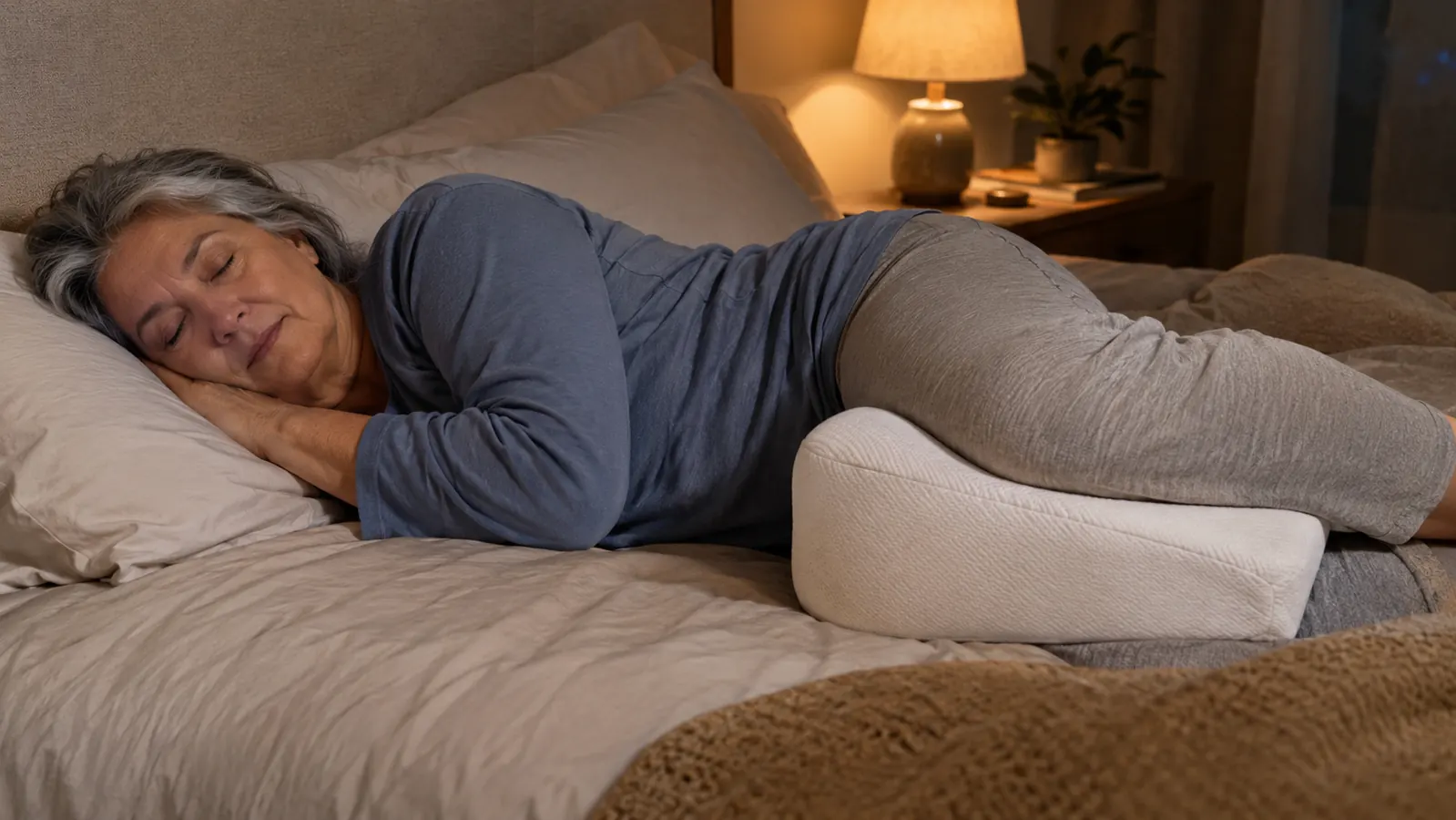
Somewhere around two in the morning, my left knee has a way of reminding me that I am sixty-two, not twenty-two. The ache is not sharp. It is more of a deep throb that settles in after I have been lying still for a while, and it is worst in the first few minutes after I turn over. My doctor calls it mild to moderate osteoarthritis. I call it the reason I have tried more pillows than I can count, including a stack of flat bed pillows, a rolled-up blanket, and one very expensive body pillow that my husband Ray ended up using. The Contour Legacy knee pillow is the one that finally stayed in my bed past the first week.
Before we go any further, let me be clear about what this article is and is not. I am not a doctor, and I am not giving medical advice. I am a retired school nurse who has spent four years figuring out how to sleep with a cranky left knee, and this is the routine that works for me. If your knee pain is keeping you up at night, check with your doctor or a physical therapist before you change anything about how you sleep. Then come back and set up your bed the way I set up mine. I will walk you through it step by step, starting with the position and ending with what to do on the mornings when your knee still complains.
The pillow that finally stayed in my bed
The Contour Legacy Leg & Knee Foam Support Pillow has more than 43,000 ratings on Amazon and a 4.3-star average. It is the pillow I reach for every single night, and it is the one I would buy again tomorrow.
Amazon Check Today's Price on Amazon →How I Use the Contour Legacy Knee Pillow at Night
Step 1: Start on your side with the pillow between your legs
Side sleeping is the position that works best for my knee, and it is the position most physical therapists recommend for people with hip or knee trouble. The trick is not just being on your side, though. It is what you do with your top leg. If you let it rest directly on top of the bottom leg, your knee presses into the mattress and your hip twists. That twist pulls on the whole chain from your lower back down to your ankle, and by morning, everything complains. I learned this the slow way, after many nights of waking up with a stiff back and an angrier knee than the one I went to bed with.
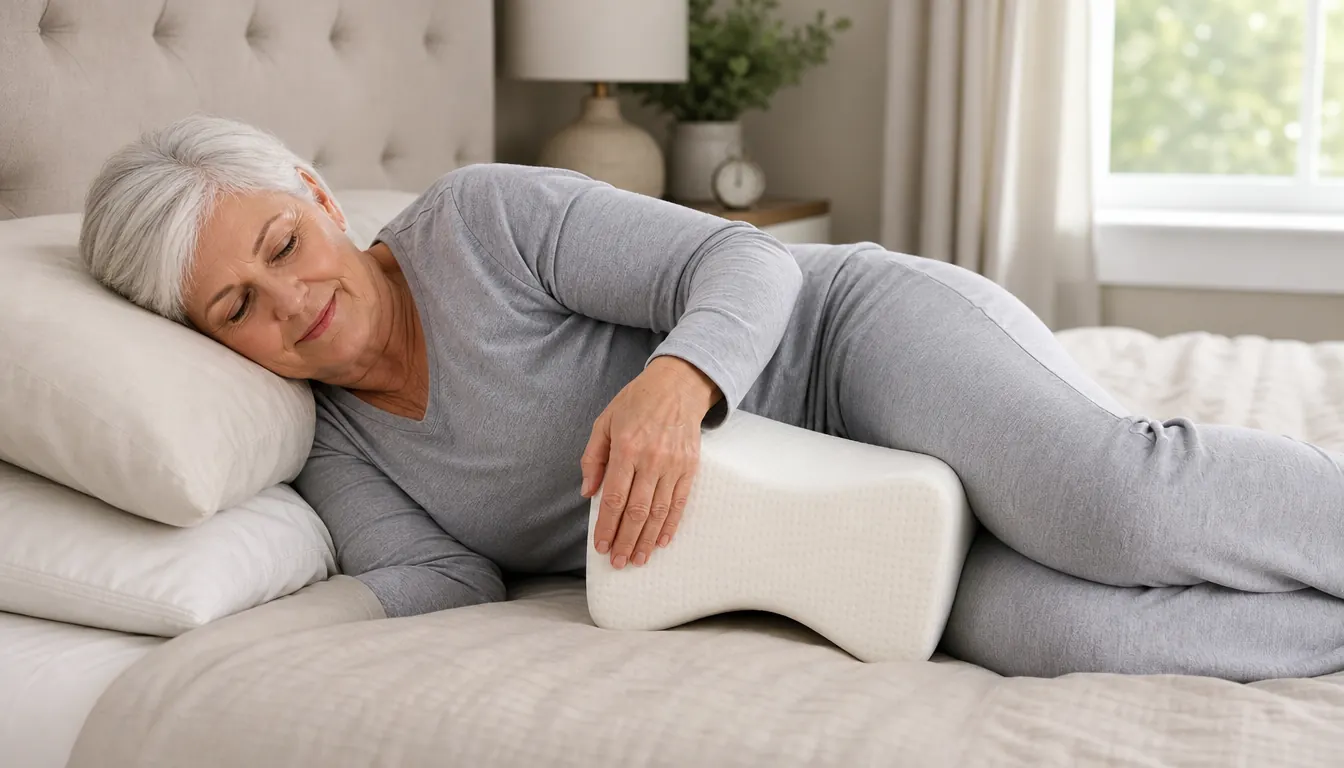
The Contour Legacy pillow sits between my legs from about mid-thigh down to my ankle. The foam is firm enough to keep my top knee from dropping toward the mattress, but it gives a little, so it does not feel like I am hugging a brick. I slide it into place before I turn out the light, and I adjust it once, maybe twice, in the first few minutes. After that, I am done thinking about it for the night. That is the whole point, as far as I am concerned. A knee pillow should be boring. If it is doing its job, you forget it is there.
If you have never slept with anything between your legs, it will feel strange for the first night or two. That is normal. Your body is used to whatever position it has been in for years, and change takes time. Give it a few nights before you decide whether the pillow is helping. I almost gave up on mine after night one, because it felt like too much pillow. I am very glad I did not, because by the third night, my body had figured out what to do with it.
Step 2: Check the height so your hips stay level
The most common mistake I made with every pillow before this one was simple: it was not thick enough. A flat pillow between your knees does not do much. Your top knee still rolls down toward the mattress, and your top hip tilts with it. The whole point of a knee pillow is to keep your top hip stacked directly over your bottom hip, and that takes a certain amount of height. Too little height, and you might as well be sleeping with a folded T-shirt.
When I first used the Contour Legacy, I paid close attention to how my left hip felt in the morning. If a pillow is too low, you will feel a pull in your lower back. If it is too high, you will feel like you are balancing on a ledge. For me, the height is just right, and my hip stays level through the night. If you are not sure about the height for your own body, give it a few nights before you judge it. Your joints need time to tell you what works, and one night is not enough data.
One thing I learned the hard way: do not stack this pillow on top of another one. I tried that during a particularly bad week, thinking more height would mean more support. It just meant my leg was propped up at an awkward angle, and my knee complained all night. The Contour Legacy is designed to do the job on its own. Let it. If you think you need more height, that is a conversation for your physical therapist, not a reason to build a pillow tower.
Step 3: Let it support your whole lower leg, not just your knee
This is the step that made the biggest difference for me. At first, I tucked the pillow under just my knee, the way you might with a regular bed pillow. It helped a little. Then I slid it down so it ran the length of my lower leg, and my ankle stopped rolling. When your ankle rolls, your knee follows, and that is when the ache starts creeping in around two in the morning. Keeping the whole leg in one line turned out to matter more than supporting the knee alone.
The Contour Legacy is made to support the whole leg, which is exactly what my left leg needs. It keeps my knee, my shin, and my ankle all in one line, so nothing twists while I sleep. I do not have to stack a second pillow under my foot to keep things straight. That one change cut my middle-of-the-night wake-ups more than anything else I tried. It also meant I stopped waking up with that pins-and-needles feeling in my foot, which was a bonus I did not expect.
To get the position right, I bend my knees slightly and let the pillow settle into the space between them. Then I straighten my legs just a little, so the pillow cradles the full length of my lower leg. It takes about ten seconds to get it right. When I wake up in the morning, the pillow is usually still exactly where I put it, which tells me I stopped moving it in my sleep. That is the sign of a good fit, in my book.
Step 4: Pair it with a short wind-down for your knee
The pillow does its job while I sleep, but I had to do a little work before I got into bed. About thirty minutes before lights out, I do two or three gentle stretches that my physical therapist gave me. Nothing dramatic, just a slow hamstring stretch and a few heel slides. Then I spend ten minutes with a heating pad on my left knee while I read a book. Ray watches television in the other room, and the house gets quiet, and my knee gets a chance to loosen up.
By the time I get into bed, my knee is warm and loose, and the pillow keeps it that way through the night. The combination matters more than either part alone. If you already have a routine from your doctor or physical therapist, do that. If you do not, ask what is safe for your knees before you add anything new. What I can tell you from my own experience is that a warm knee settles faster than a cold one, and a knee that is already relaxed is easier to keep comfortable all night.
I also stopped drinking coffee after dinner. This is not knee advice, exactly, but a full bladder is a terrible thing for anyone with a stiff knee, because you end up walking to the bathroom in the dark with legs that have been still for hours. The fewer times I have to get up, the better my knee feels in the morning. Small changes add up, and this one was nearly free.
Step 5: Know what to do when you wake up stiff
Even with the pillow, I still have mornings where my left knee is stiff. That is the nature of osteoarthritis, and I do not expect any pillow to erase it. What the Contour Legacy changed is how I wake up. Before, I would roll out of bed and hobble to the bathroom, holding the wall. Now I take a minute to bend and straighten my knee a few times while I am still lying down, and then I roll to my side and push myself up with my arms. It sounds small, but those first few steps are a lot easier.
If you wake up in the middle of the night, do not yank the pillow out from between your legs. Keep it where it is and turn your whole body at once, so your hips and shoulders stay lined up. When I switch sides, I take the pillow with me and tuck it between my legs on the new side. It sounds like a small thing, but it keeps my knee from twisting in the dark. I have done it enough times now that I do it without waking up fully.
The other thing I learned is to give the whole routine a full week before you judge it. The first night I used the Contour Legacy, I was not sure it was any better than the flat pillow I had been using. By the third night, I stopped reaching down to adjust it. By the end of the week, it was just part of my bed, like my reading glasses on the nightstand. That is when I knew it was a keeper, and it has been in my bed ever since.
What Else Helps
The pillow is the centerpiece of my setup, but it is not the only thing that helps. I keep my mattress on the firmer side, because a sagging mattress makes my knee ache no matter what pillow I use. I also stopped sleeping on my stomach, which was twisting my left leg all night. And I put a small folded blanket under my bottom ankle for extra cushioning, since that ankle takes some weight when I sleep on my side. None of these things are dramatic, but they all add up.
None of this is medical advice. It is what works in my house, and everyone's knees are different. If you are not sure where to start, pick one change and give it a week, then see how your knee feels in the morning. For me, the Contour Legacy was the change that made the rest of my routine finally stick. My left knee is not cured, and I do not expect it ever will be. But I sleep through the night now, and that is worth a lot at my age.
When It Might Not Be Enough
Honestly, a knee pillow is a comfort tool, not a treatment. If your knee pain comes from an injury that has not healed, or if it is getting worse instead of staying the same, a pillow is not the answer. The same goes for swelling, redness, or pain that does not ease when you change position. Those are reasons to call your doctor, not reasons to shop for more bedding. I say this as someone who spent a little too long hoping a pillow would fix things that needed a doctor.
There are also nights when my knee hurts no matter what I do. On those nights, the Contour Legacy does not fix anything, but it does keep me from making things worse by twisting my leg while I toss and turn. I think of it as a way to protect my knee while I sleep, not as a cure. If you go into it with that expectation, you will not be disappointed. If you go into it expecting your knee to be perfect by morning, you will be, and I would rather you hear that from me than find out at two in the morning.
Three nights in, I stopped reaching down to adjust the pillow. A week in, I stopped thinking about my knee at two in the morning.
Give your knee a full week before you judge it
The Contour Legacy Leg & Knee Foam Support Pillow has a 4.3-star average across more than 43,000 ratings. It worked for my left knee, and it might work for yours. Check the current price on Amazon and see if it belongs in your bed.
Amazon Check Today's Price on Amazon →