
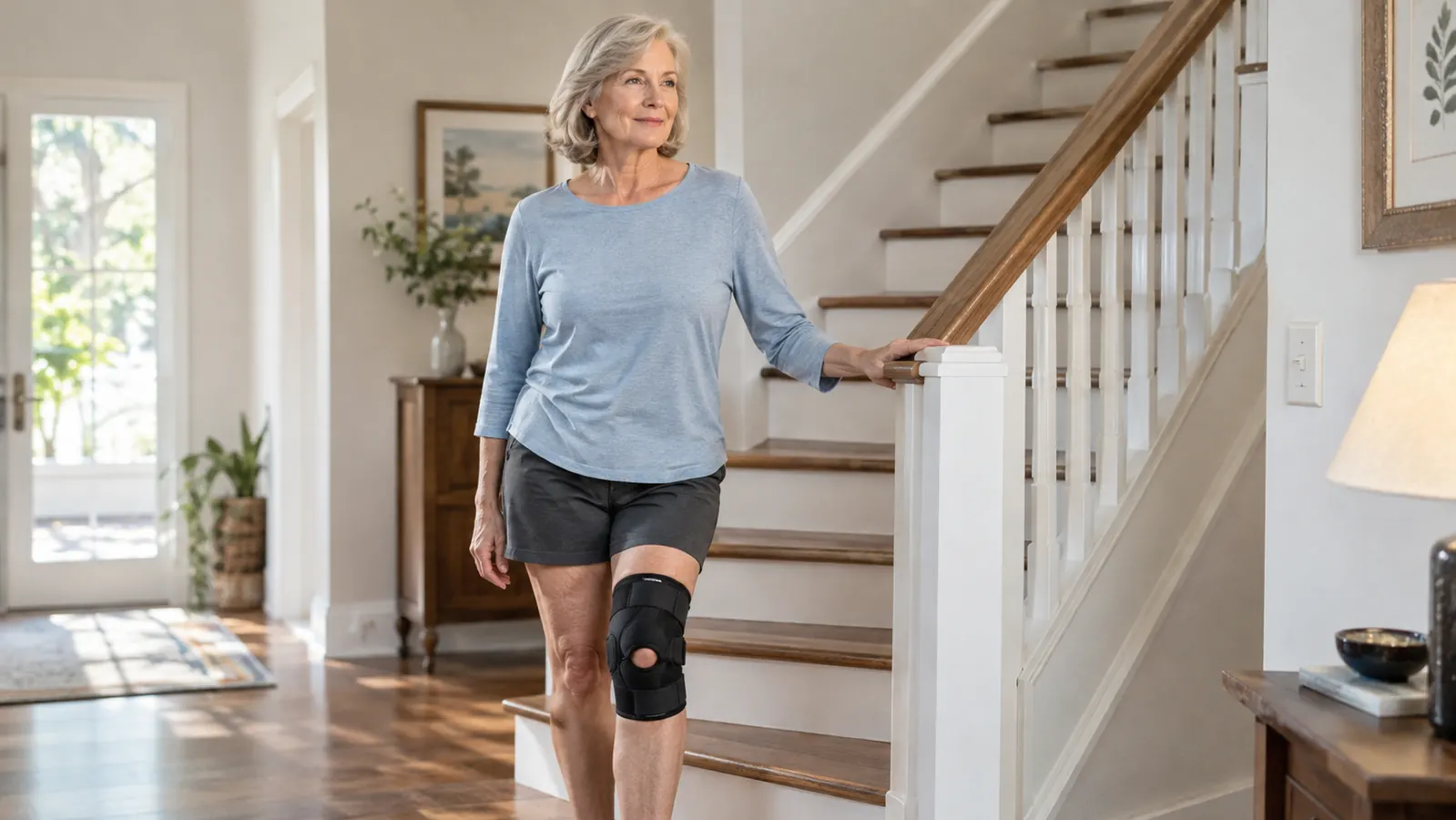
I will tell you straight: stairs are the hardest thing I do with my left knee. On flat ground I can walk the neighborhood for an hour, but put a flight of steps in front of me and that knee lets me know about it with every single stair. I am Gail Whitford, 62, a retired school nurse in Tulsa, Oklahoma. I have had osteoarthritis in my left knee for about four years. The right knee is fine, which somehow makes the left one feel even more like a traitor.
Before I found a routine that works, I tried everything. I tried going up stairs sideways, leading with my good leg. I tried taking them two at a time so the bad knee only had to do half the work. I tried avoiding stairs altogether, which works fine until you need the upstairs bathroom or your grandkids want you to come see their fort. What finally helped was the ELITE knee brace from DR. BRACE, with side stabilizers and a gel pad around the kneecap. But here is what I learned: the brace alone was not enough. The brace plus a few simple habits is what actually got me up and down the stairs without wincing.
Why Stairs Are So Hard on an Achy Knee
Every step up puts your whole body weight on one leg, and every step down adds a little shock on top of it. With arthritis, the cartilage that normally cushions the joint has worn thin, so that shock lands on bone and on the soft tissue around it. That is why the knee aches more on stairs than it does on a flat sidewalk. It is not in your head, and it is not because you are out of shape. It is basic physics meeting a worn-out joint.
The other problem is that stairs force your knee to bend and straighten under load, which is exactly the motion that hurts when the joint is stiff. That is why the first few steps in the morning are the worst. A brace does not fix the cartilage, and I want to be clear about that. What it does is hold the knee in better alignment, give the joint a little extra stability, and take some of the load off the sore spots. DR. BRACE's ELITE has side stabilizers and a gel pad, and for me that combination made the difference between dreading the stairs and just using them.
The brace I reach for on staircase days
The DR. BRACE ELITE knee brace with side stabilizers and patella gel pads is the one I put on when I know stairs are ahead. It supports the knee without feeling like a cast, and it stays put through a full trip up and down.
Amazon Check Today's Price on Amazon →Step 1: Put the Brace On Before You Need It
The biggest mistake I made at first was waiting until my knee already hurt before I put the brace on. By then the joint was angry, and the brace was just trying to catch up. Now I put the DR. BRACE ELITE on before I need it, especially on days when I know stairs are coming. If I am going to babysit my grandkids on Friday, I put it on before I leave the car. If I am doing laundry upstairs, I put it on before I pick up the basket.
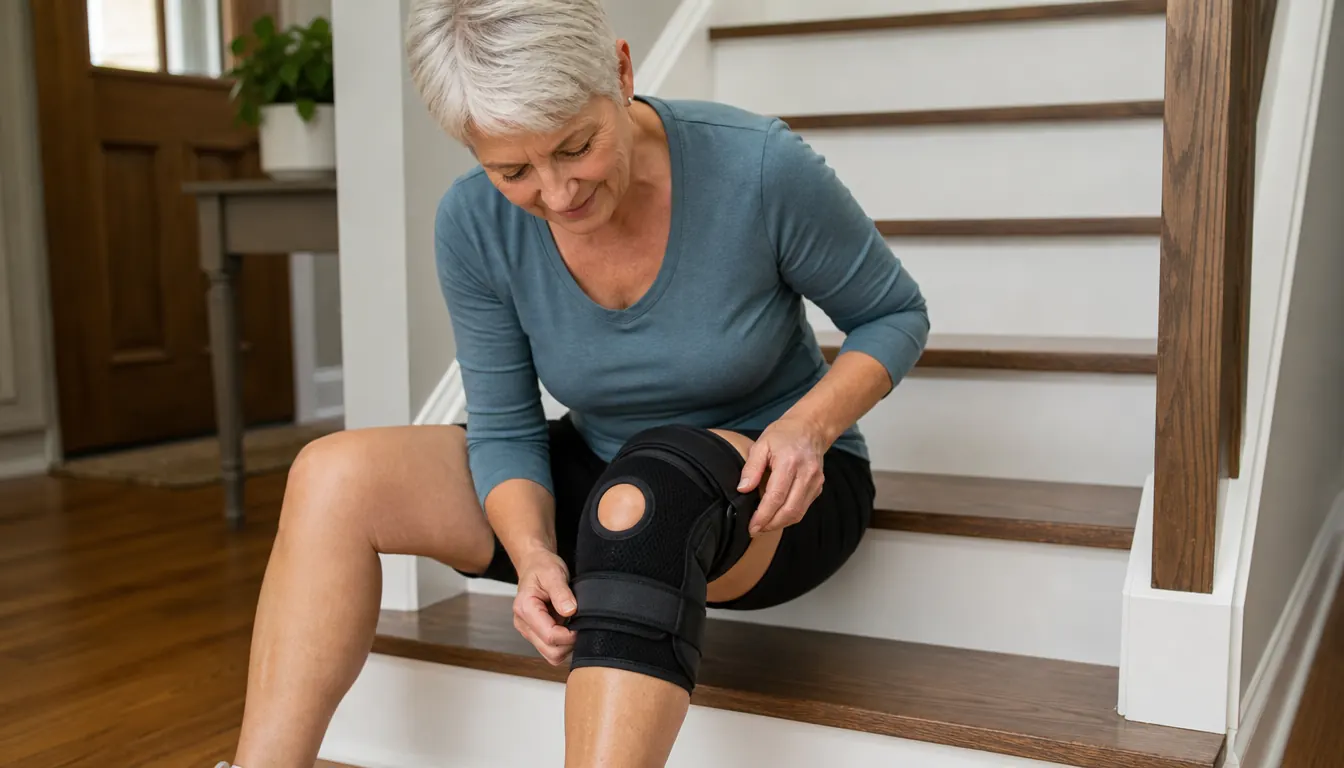
Putting it on right matters as much as putting it on early. I sit on the bottom step, bend the knee, and make sure the gel pad sits right over the kneecap. The side stabilizers should run along the outside and inside of the knee, not twisted around to the front or back. Then I pull the straps snug, one at a time, until the brace feels like a firm hand holding the knee, not a vise. I bend and straighten the leg a few times to check the fit before I stand up.
One more thing: the brace works best over a thin layer of clothing or directly on the skin, whichever you find more comfortable. I wear it over thin leggings in cool weather and directly on the skin in summer. If the straps leave red marks after an hour, they are too tight. Loosen them and start again.
Step 2: Warm Up the Knee Before the First Step
A stiff knee does not want to climb stairs, and no brace in the world changes that. What helps is two or three minutes of gentle movement before the first step. I do this at the bottom of the stairs, holding the railing with one hand. I march in place for about a minute, lifting each foot just a few inches. Then I do ten slow leg swings, front and back, holding the railing for balance. It looks a little silly, but it works.
The reason is simple: joint fluid moves when you move. A few minutes of easy motion spreads that fluid through the knee and makes the joint noticeably less stiff. I noticed the biggest difference in the morning, when my knee is at its worst. Those first few steps used to make me gasp. Now, after a quick warm-up with the brace on, the first step is still not pleasant, but it is nowhere near as bad.
If you have a physical therapist, ask them for warm-up moves that fit your knee. My therapist gave me a short list, and I do it most mornings whether I am facing stairs or not. The stairs are just the place where I notice the payoff most.
Step 3: Use the Handrail and the Good Leg Up, Bad Leg Down Rule
There is an old rule for climbing stairs with one bad knee: up with the good, down with the bad. Going up, lead with your stronger leg and bring the weaker one up to meet it. Going down, lead with the weaker leg and let the stronger one take the load. The idea is that the strong leg does the lifting and the lowering, while the bad knee only has to bend and follow along.
The handrail is not optional for me anymore. I use it every single time, even when I think I do not need it. The rail lets my arm share the work, and it gives me something solid to grab if the knee gives a sudden twinge. With the DR. BRACE ELITE holding the knee steady and the rail taking some of the weight, I feel like I have two helpers instead of one.
One stair at a time, every time. I put my whole foot on each step, not just the toes or the heel. When I tried to rush, taking stairs two at a time or moving at the speed I used to, that is when the knee complained the loudest. The brace cannot fix a bad decision. It can only steady the knee while you make a good one.
Step 4: Take It Slow and Keep Your Weight Centered
Nobody likes being slow on the stairs, but slow is what works. I keep my chest up and my eyes on the next step, not on my feet. I try to keep my weight centered over my legs instead of leaning forward into the climb. Leaning forward puts extra pressure on the front of the knee, which is exactly where arthritis likes to hurt.
If I am carrying something, I make two trips or I use a bag I can wear across my body. Carrying a laundry basket up the stairs was one of the worst things I did to my knee, because one hand was on the basket and the other was nowhere near the rail. Now the basket goes up first, or I slide it up a couple of stairs at a time while I climb. It takes longer and it looks ridiculous, but my knee does not pay for it later.
Plan your route when you can. At home I keep things I use often on the ground floor, so I only face the stairs a few times a day instead of a dozen. When I am out, I look for the ramp or the elevator even if it means walking a little farther. Saving the knee for the stairs that matter is not lazy, it is smart.
Step 5: Cool Down and Give the Knee a Break Afterward
The work is not over when you reach the top. I sit down for a minute, straighten the leg out in front of me, and do a few quad sets. That means tightening the muscle on the front of the thigh and holding for five seconds, then relaxing. Ten of those, and the knee feels less angry than it used to after a climb.
If the knee is sore after stairs, I ice it for fifteen minutes while I put my feet up. I take the brace off after a few hours so the skin can breathe, and I do not sleep in it. The DR. BRACE ELITE is a tool for the active part of the day, not a permanent wrap.
Know the difference between achy and alarming. A little soreness after stairs is normal for a knee with arthritis. Swelling, sharp pain, a feeling that the knee is going to give way, or pain that lasts for days are signals to slow down and talk to your doctor or physical therapist. I am a retired nurse, but I am not your nurse, and I will never tell you to push through pain. The brace helps, and the routine helps, but they are not a substitute for a professional opinion.
What Else Helps
The brace is one piece of the puzzle. What moved the needle most for me was the short home exercise routine my physical therapist gave me: quad sets, straight leg raises, and a few balance exercises. Ten minutes, most days. It did not make my knee young again, but it made it steadier, and a steadier knee is easier to brace and easier to take down the stairs.
Shoes matter more than I expected. I switched to walking shoes with good grip and firm support, and I stopped wearing slippers on the stairs. Slippers slide, and a slide on the stairs is the last thing a knee with arthritis needs. I also keep my weight in a healthy range, which takes pressure off the joint, and I try to stay active even on days when the knee complains. Movement, within reason, keeps the joint from stiffening up completely.
The other thing that helped was consistency. The brace works when I use it, and the exercises work when I do them. There is no magic to it. I keep the DR. BRACE ELITE on a hook by the back door, next to my walking shoes, so I do not have to go looking for it when I need it. Small habits, repeated daily, are what made the stairs feel manageable again.
The first morning I wore the DR. BRACE ELITE, I went up and down our staircase three times without stopping to grip the railing and catch my breath. That had not happened in months.
When the Brace Is Not Enough
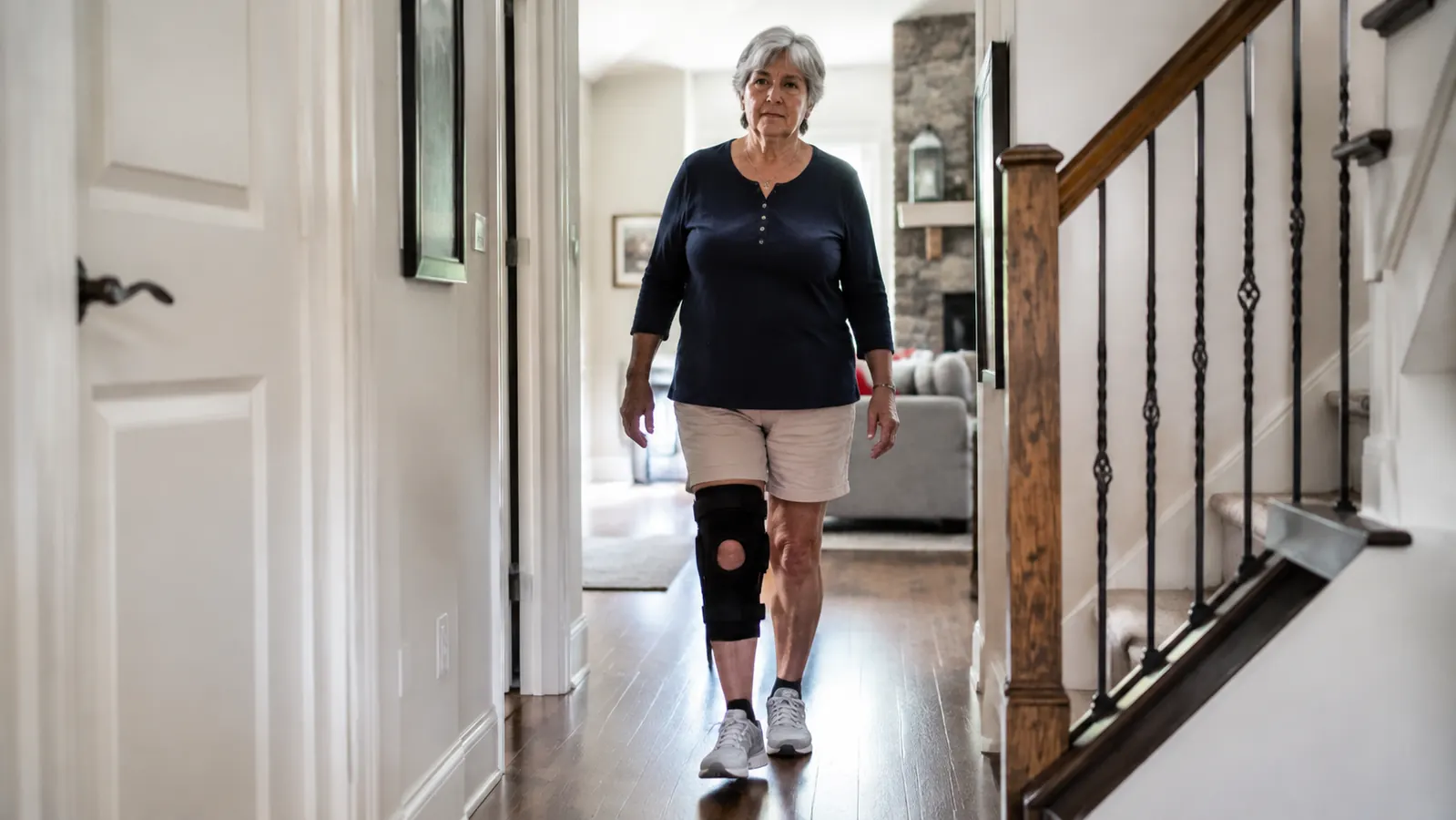
I want to be honest about where DR. BRACE's ELITE falls short. It is not a cure for arthritis, and it will not fix a knee that needs medical attention. If your knee is swollen, if it locks or gives way, or if the pain keeps you up at night, a brace is not the answer. That is a conversation for a doctor or an orthopedic specialist. For me, the brace is the difference between using the stairs and dreading them. That is a real difference, and it is worth having, but it is not the same as a healthy knee.
If stairs are the hardest part of your day, this is worth a try
The DR. BRACE ELITE is the brace I keep by the bottom of the stairs. It will not cure an arthritic knee, but it makes the climb steadier and less painful, and that is a win I will take every day.
Amazon Check Today's Price on Amazon →