
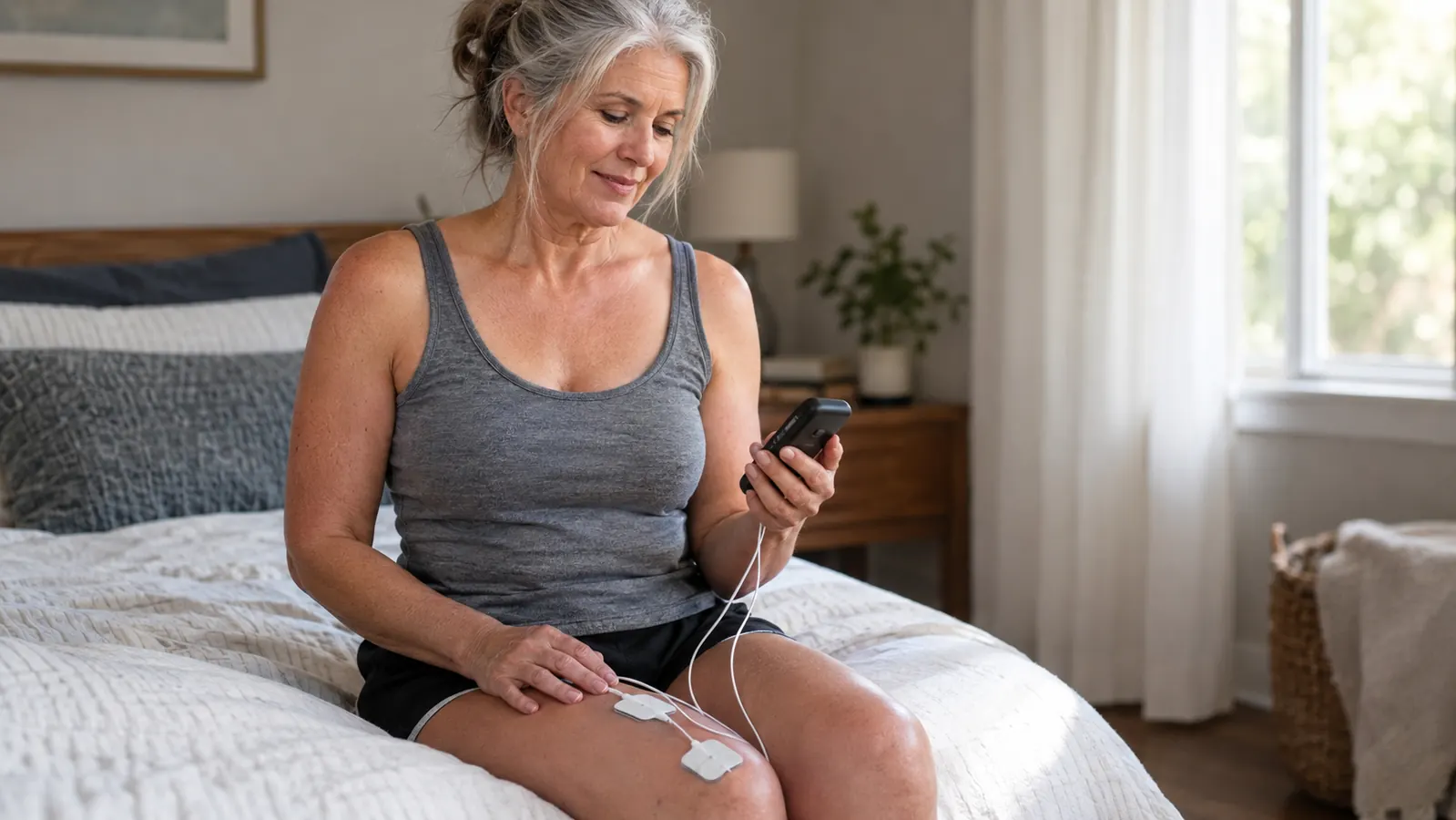
If you have a knee that aches when you stand up from a chair, or stiffens up on long car rides, you have probably wondered whether those little electrode pads people wear actually do anything. I wondered the same thing before I tried the AUVON TENS unit on my own left knee. I am a 62-year-old retired school nurse in Tulsa, and my left knee has mild to moderate osteoarthritis. I am not here to tell you that a TENS unit cures anything, because it does not. But I can tell you exactly how to place the pads so the device has the best chance of helping, and where the whole approach tends to fall short.
The hardest part of using a TENS unit on a knee is not the device. It is the placement. The knee is a hinge, not a flat surface, so pads that sit perfectly on a forearm or a back will lift, bunch, or miss the nerves they are meant to reach. In this guide I walk through five steps for placing AUVON pads around the knee, what each position does, and how to get a good stick even on a bony joint.
The AUVON TENS unit I keep reaching for on stiff mornings
It has 24 modes, comes with premium pads that actually stick, and the leads are simple enough for my arthritic fingers to manage. Check today's price on Amazon before you order pads separately.
Amazon Check Today's Price on Amazon →Step 1: Read the manual once, then put it away
Before you place a single pad, read the instructions that come with your AUVON TENS unit. I know that sounds like the boring part, but the manual tells you where not to put pads, how long a session should last, and what to do if the skin gets irritated. That last part matters more than people think. I keep my manual in the drawer with the device so I can check the settings without guessing. The first time I ever tried a TENS unit, years before I bought the AUVON, I skipped the manual and stuck the pads wherever they landed. One pad ended up half on my kneecap, and the session felt wrong from the first minute. I turned it off after five minutes. When I finally read the diagram, I saw exactly what I had done wrong.
The AUVON unit I have offers 24 modes, and the manual explains what each mode is for. The modes are grouped by type, and the names are plain enough: massage, kneading, tapping, acupuncture, and a few I have not touched. I mostly use the massage and kneading settings on my knee, but I have tried the acupuncture mode on my calf and the tapping mode on my thigh. Each one feels different, and the manual told me which to expect before I turned the dial. Start on the lowest intensity the first time. You want a strong tingle, not a grab. If it hurts, it is too high.
One thing the manual will tell you is to avoid placing pads directly over the kneecap or on the front of the neck. The kneecap is too bony for the current to spread evenly, and the front of the neck is never a safe spot for electrodes. Keep the pads on the fleshy areas above and below the knee, and you are already doing better than most first-timers.
Step 2: Clean the skin and dry it completely
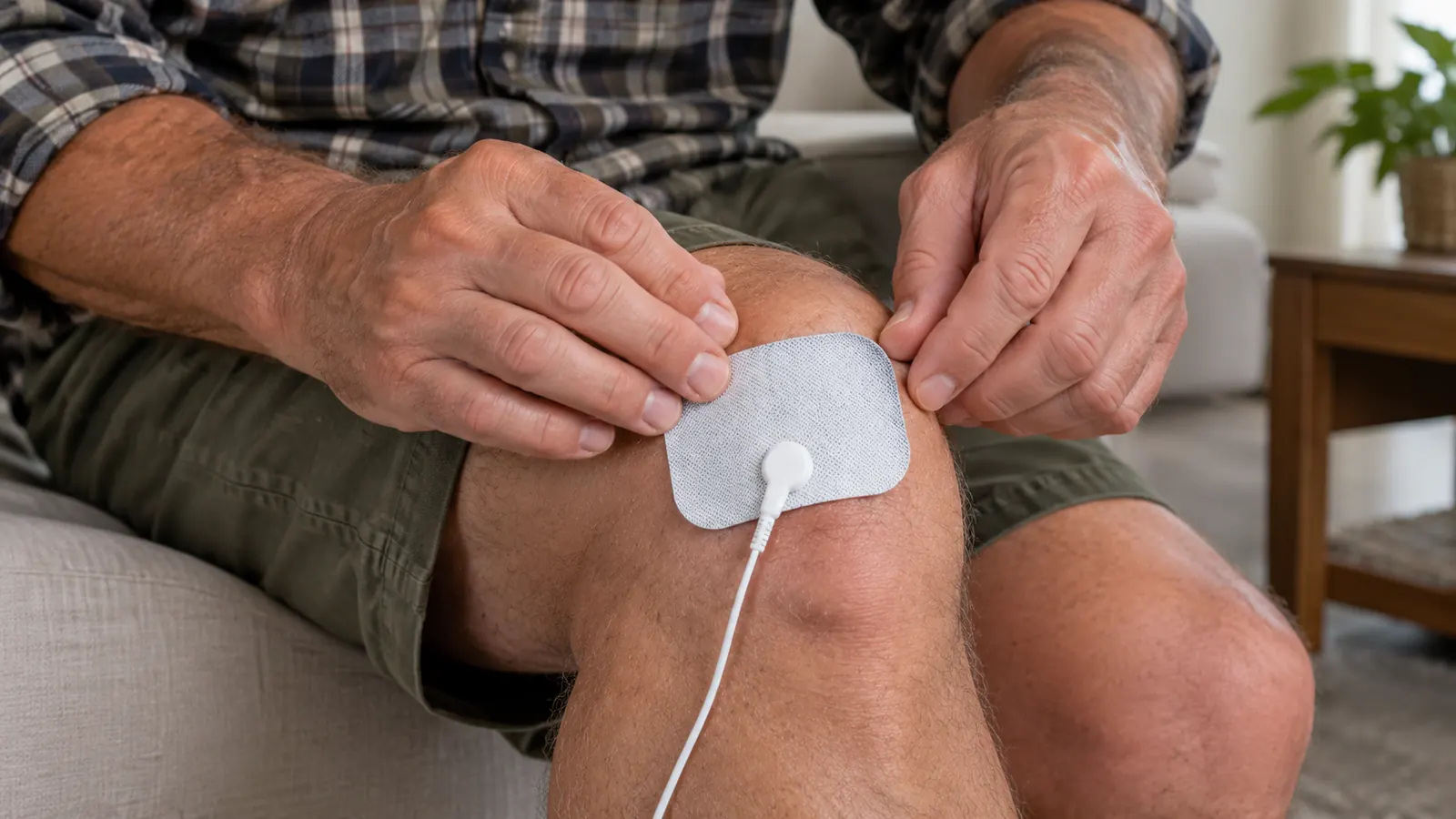
A TENS pad only works if it is actually touching your skin. Lotion, sweat, and leftover ointment all sit between the pad and the skin, and they can turn a good stick into a pad that falls off after ten minutes. I wash my knee with plain soap and water, dry it with a clean towel, and wait a minute to make sure there is no moisture left. I do not use rubbing alcohol every day because it dries out the skin, but once in a while it is fine.
If you have just put on a pain relief cream or a menthol rub, wash it off before placing the pads. The cream can irritate the skin under the pad, and it can also make the pad lose its grip. This is one of those small steps that separates a session that helps from a session that ends with you holding a pad that will not stick.
Step 3: Place the pads around the knee, not on it
The classic setup for knee pain is four pads: two above the knee and two below, or two on the inner side and two on the outer side. The idea is to run the current through the area around the joint rather than straight across the kneecap. With the AUVON TENS unit, I place one pad a few inches above the knee on the inner thigh, one a few inches above on the outer thigh, and the matching pair below the knee on the inner and outer calf. That gives the current a wide path around the joint. I use my fingers to measure the gap. Two finger widths above the kneecap and two finger widths below is the spacing that works for me. When I first started, I placed the pads too close to the joint, and the current felt like it was buzzing right on the bone. Moving them up and down by an inch changed the sensation completely.
Another placement I use when the ache is more on one side is a two-pad setup: one pad on the inner side of the knee and one on the outer side, roughly level with the middle of the kneecap but not on it. This works well for the kind of pain that sits on the side of the joint. Whichever setup you choose, keep a little space between the pads. If two pads touch each other, the current takes the shortest path and you feel a sharp pinch instead of a spreading tingle. The inner thigh placement is the one I had to practice. It is awkward to reach, and I had to sit down and prop my leg up to get the pad flat. Once I got the angle right, the current seemed to travel through the whole inner side of the knee, which is exactly where my arthritis likes to ache.
Do not place the pads on the kneecap itself. The bone is close to the surface there, and the current can feel unpleasant or even sharp. The fleshy areas above and below the knee give the current something to spread through, which is exactly what you want when the goal is a dull, soothing sensation.
Step 4: Press each pad down firmly, then check the stick
When the pads are in position, press each one down with the flat of your finger, starting at the center and working toward the edges. This pushes out any air bubbles and gives the whole pad surface a chance to grip. The premium pads that come with the AUVON unit are sticky out of the package, but they still need a firm press to seat properly on a curved knee. I also check the stick by running a finger along the edge of each pad. If the edge lifts at all, I press it down again. A pad that starts out loose will only get looser once the unit is on.
After you press the pads down, bend your knee slowly once or twice before you turn the unit on. If a pad lifts or crinkles when you move, press it back down. It is much easier to fix a loose pad before the session starts than to stop mid-session and start over. I have learned this the hard way more than once.
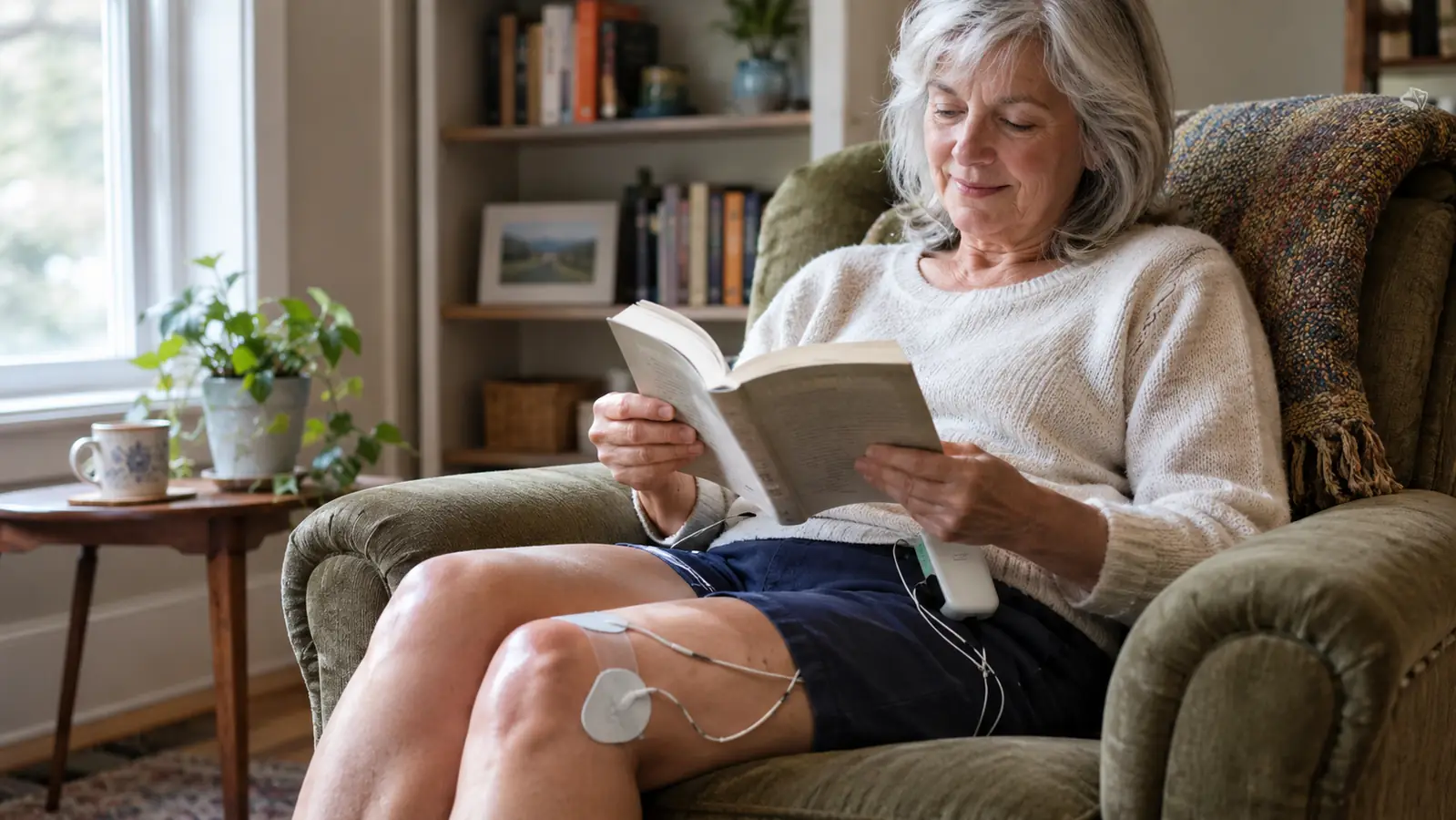
If you are using the AUVON unit while walking around the house, clip the device to your waistband and give the wires a little slack. Tugging on the leads is one of the main reasons pads peel off mid-session. A little slack between the device and the pad makes the whole setup stay put. The first time I used the AUVON while walking to the kitchen, the wire caught on the edge of the counter and the pad peeled off the side of my knee. I had left too much slack, and the tug pulled the pad right off. Now I clip the device to my waistband on the same side as the knee and tuck the wire under my shirt. It stays put, and I can move around without thinking about it.
Step 5: Start low, go slow, and stop if it feels wrong
Turn the AUVON TENS unit on at the lowest intensity and work up gradually. The right level feels like a strong, steady tingle or a gentle pulsing. It should not feel like a muscle cramp, and it should never hurt. I usually run about 20 minutes on my knee, and I keep the intensity in the middle range. Some modes feel better than others on a particular day, so I switch between them until I find the one that suits the moment. I time my sessions with the timer on the unit. Twenty minutes is my usual, and I set it before I start so I am not watching the clock. On a bad morning I will do a second session in the afternoon, but I always leave a few hours in between. The skin needs a break, and the pads stick better the second time if they have had time to rest.
If the sensation feels too weak, move the pads a little closer together rather than turning the intensity way up. If it feels too sharp, move them farther apart. This is the trick that took me the longest to learn: placement does more than power. A small adjustment in pad position often does more than a big jump in intensity.
Stop the session if your skin turns red in a blotchy pattern, if the sensation is painful, or if you feel dizzy. And if you have a pacemaker, are pregnant, or have any doubt about whether TENS is safe for you, check with your doctor before you ever turn the unit on. I say this as a retired nurse and as someone who has had good results: TENS is a tool, not a toy, and it is not for everyone. One thing I have noticed is that the sensation changes as the session goes on. The first few minutes feel strong, then it settles into a steady hum. If it starts to feel sharp, I lower the intensity rather than pushing through. Sharp is never good.
What Else Helps
A TENS unit works best when it is part of a routine, not the whole routine. On days when my left knee is stiff first thing in the morning, I use the AUVON unit while I drink my coffee, then do a few gentle knee bends and a short walk around the block. The combination of the electrical stimulation and moving the joint helps more than either one alone. My physical therapist also reminds me that strengthening the muscles around the knee matters more than any gadget, so I keep up with my home exercises even on days when the knee feels fine.
I also learned to pay attention to the pads themselves. The AUVON pads last a good while if you store them on the plastic sheet they come with, keep them out of direct sunlight, and do not wash them with soap and water. When a pad stops sticking well, replace it. A pad that will not stay on is not saving you money, it is just a pad that does not work.
Placement does more than power. Moving the pads an inch can change the whole session, and that is the lesson that took me the longest to learn.
Try the AUVON TENS unit for your own stiff knees
If you want a TENS unit with clear controls, plenty of modes, and pads that hold up, the AUVON model is the one I keep coming back to. Check today's price on Amazon and see if it fits your routine.
Amazon Check Today's Price on Amazon →